
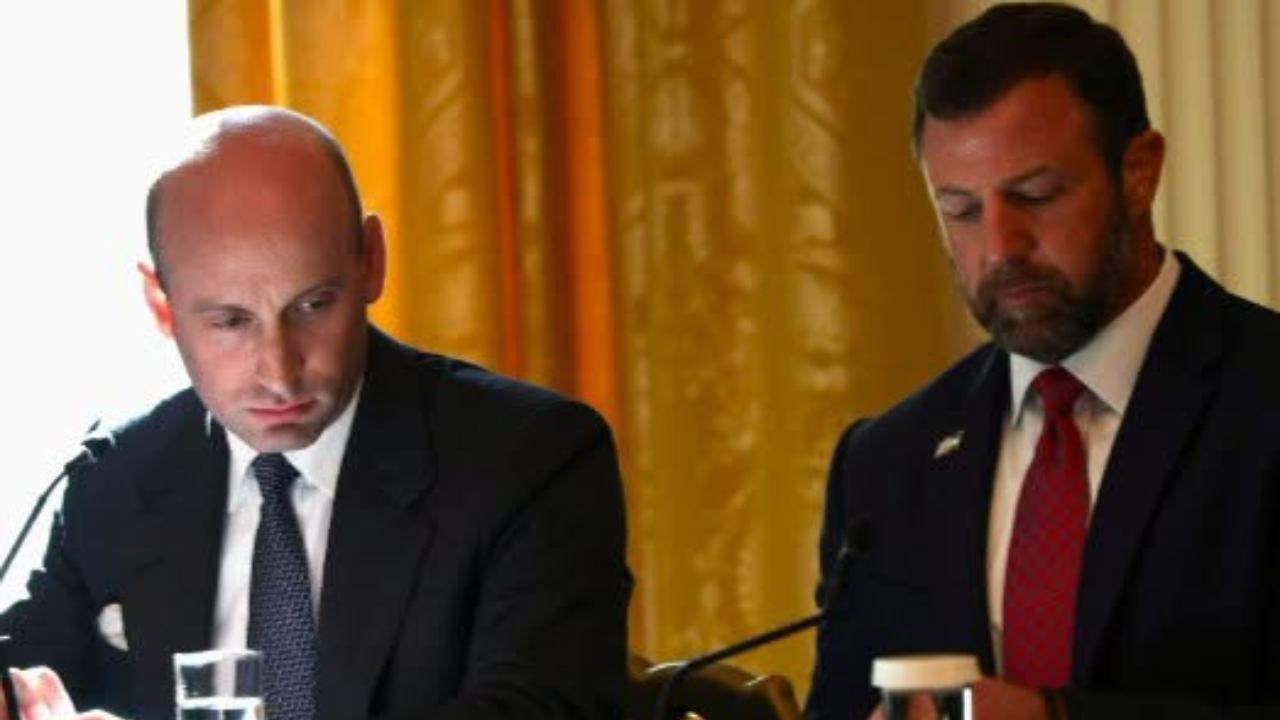
White House Chief of Staff Stephen Miller reportedly intervened to remove Homeland Security Secretary Markwayne Mullin from television appearances after a series of public statements frustrated senior officials inside President Donald Trump’s administration.
According to reporting by Politico, Mullin was placed in what insiders described as a “primetime time-out” after his handling of recent nationwide technology disruptions created confusion and prompted criticism within the White House.
The intervention came as Miller, newly appointed to lead Trump’s White House staff, was traveling with the president in Manila.
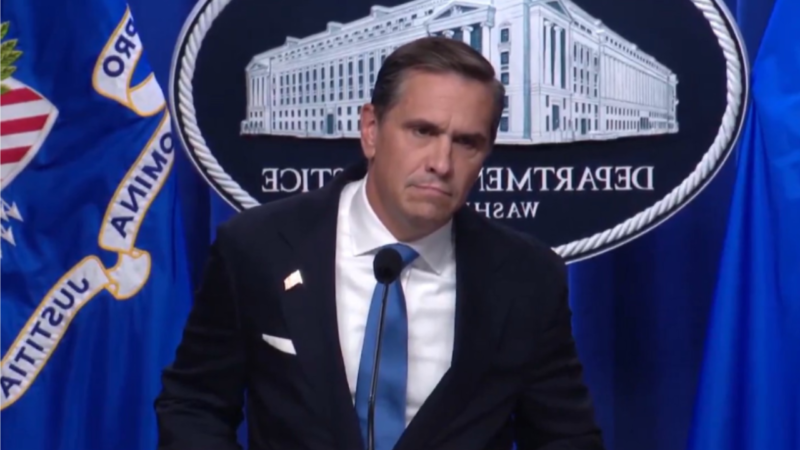
Despite being thousands of miles from Washington, Miller reportedly directed a change in the administration’s public communications strategy, replacing Mullin with Director of National Intelligence Jay Clayton and Secretary of State Marco Rubio to explain the disruptions.
The decision followed several days of mounting frustration over Mullin’s public remarks.
The most notable incident occurred during a Monday appearance on Fox News, when Mullin spoke with Sean Hannity about technology failures affecting major American institutions.
Those disruptions included a nationwide Federal Aviation Administration ground stop, problems with Microsoft’s services, interruptions involving JPMorgan Chase and issues affecting other communications networks.
Rather than relying exclusively on the findings of federal cybersecurity investigators, Mullin introduced a theory from an unnamed acquaintance in the technology industry.
The secretary suggested that artificial intelligence, which the administration has referred to as “superintelligence” or “SI,” might have contributed to the failures.
He cited someone he described as knowledgeable about technology, while acknowledging that the individual was not Elon Musk.
The speculation reportedly caused immediate alarm among White House officials.
According to Politico, internal administration group chats erupted with reactions including “WTFs” as aides watched the interview.
The concern was not simply that Mullin had mentioned artificial intelligence. Officials were reportedly frustrated that the secretary responsible for homeland security was publicly discussing an unverified explanation while the administration was trying to reassure Americans that the disruptions were not part of a coordinated cyberattack.
The White House subsequently emphasized that investigators had found no indication of malicious foreign cyberattacks or artificial-intelligence-related attacks behind the incidents.
Individual technology providers also identified more conventional explanations.
Microsoft attributed its service disruption to a software problem, while JPMorgan Chase pointed to a technical issue affecting its banking systems.
Transportation officials linked the FAA’s nationwide ground stop to problems involving networking equipment.
The disruptions were serious, particularly for air travelers, but available findings did not establish that the incidents were connected or deliberately caused.
Mullin’s statements nevertheless complicated the administration’s efforts to present a consistent explanation.
By Tuesday, Miller had reportedly decided that other senior officials should take the lead in communicating with the public.
A White House official defended the intervention as an example of Miller’s ability to coordinate the administration.
The official argued that the chief of staff could bring Cabinet members together and ensure that the government delivered a unified message.
But Mullin’s problems with the White House reportedly extended beyond the technology outages.
Earlier in November, the Homeland Security secretary had expressed openness to discussing immigration legislation that could provide permanent legal status to certain undocumented immigrants brought to the United States as children.
The comments concerned recipients of Deferred Action for Childhood Arrivals, commonly known as DACA.
Mullin suggested that Congress could consider a framework allowing some of those individuals to obtain permanent legal status.
He indicated that he was willing to discuss possible proposals, while emphasizing that Congress would ultimately be responsible for legislation.
That position drew criticism from immigration hardliners associated with Trump’s political movement.
Miller, a longtime architect of the administration’s restrictive immigration policies, has consistently opposed broad legalization measures for undocumented immigrants.
According to the reporting, Mullin’s comments on immigration contributed to the frustration that eventually led to his removal from the administration’s television response to the technology outages.
The episode is especially notable because Miller had only recently assumed the position of White House chief of staff.
Trump appointed him following the Republican Party’s losses in the November midterm elections, replacing Susie Wiles.
The reported intervention demonstrates how Miller has begun exercising authority over the administration’s public messaging, including the appearances of Cabinet-level officials.
Mullin, a former Oklahoma senator and businessman, became Homeland Security secretary earlier in 2026.
His department oversees a vast portfolio that includes immigration enforcement, border security, cybersecurity and coordination with other federal agencies during national emergencies.
The secretary’s responsibilities made his public explanations particularly consequential during the technology disruptions.
Mullin had also faced criticism for traveling aboard a government aircraft to attend a college football game in Louisiana while travelers were dealing with the aftermath of the FAA shutdown.
He defended that trip, arguing that airspace had reopened and that his willingness to fly demonstrated confidence in aviation safety.
The explanation did not end the controversy.
His handling of the outages, combined with his immigration remarks, added to the scrutiny surrounding his leadership.
Despite the reported decision to sideline him from television appearances, the White House has publicly maintained confidence in Mullin.
Officials have characterized the communications changes as an effort to coordinate the administration’s response rather than as a formal disciplinary action.
There has been no announcement that Mullin has been removed from office or that his Cabinet position has changed.
Nevertheless, the reported “primetime time-out” illustrates the difficulties the administration has faced while responding to a series of highly visible infrastructure disruptions.
It also highlights the authority Miller is exercising in his new role.
For a Cabinet secretary responsible for explaining threats to American security, being replaced as a principal public spokesperson represents a notable development.
And the reported reactions inside the White House suggest that Mullin’s comments created precisely the kind of confusion the administration was trying to avoid.
Leave a Reply